
NBA Betting Data Feeds: How Sportradar and Official Data Shape Your Odds
 Available in US
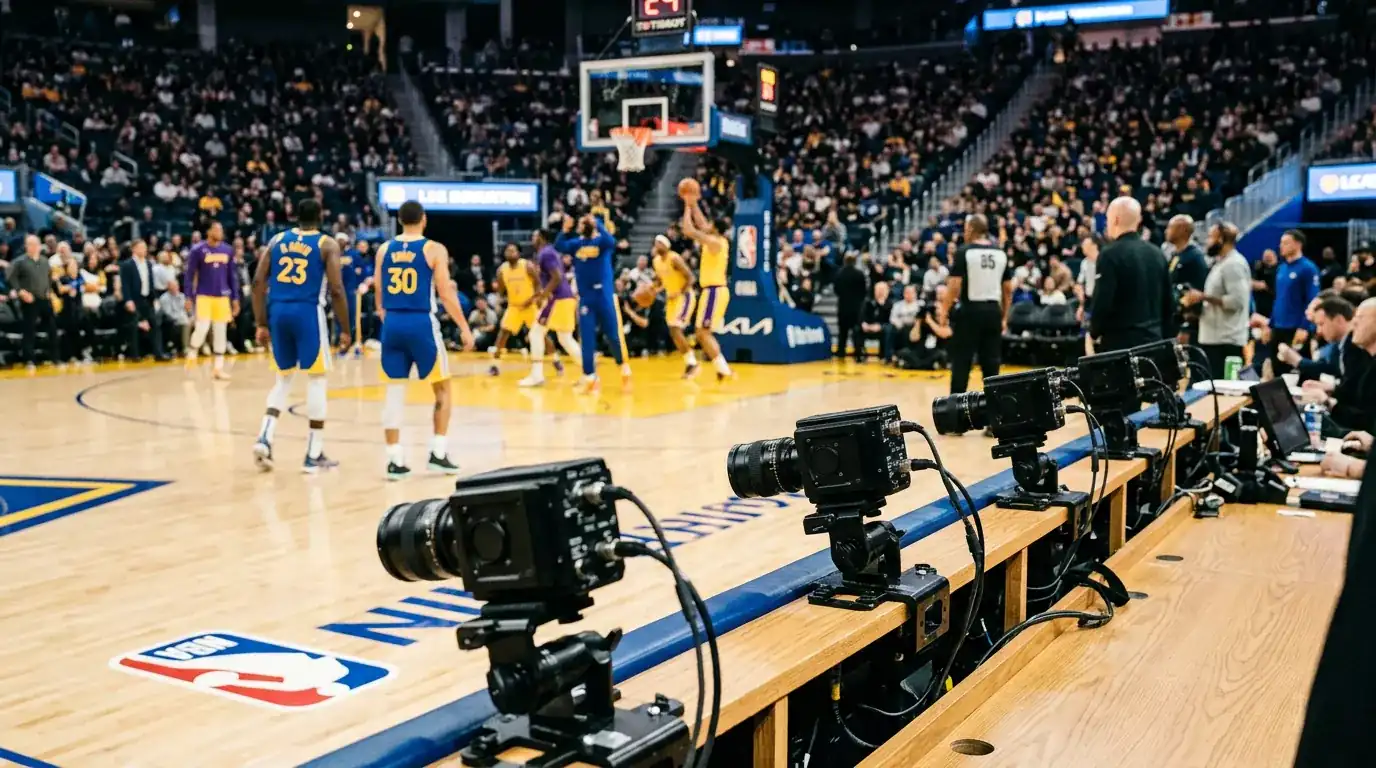
Every NBA odds movement you see at your UK bookmaker — every shift in the spread, every player prop adjustment, every live-betting price update — starts with a data feed. Not a hunch, not a trading team’s gut feeling, but a structured stream of numbers flowing from courtside sensors through processing engines and into the pricing models that generate the odds on your screen. Understanding that pipeline changed how I evaluate odds entirely, because it revealed that the price I am betting against is not set by a person but by a system, and systems have knowable characteristics.
The NBA’s official data infrastructure is anchored by a single, massive deal: Sportradar paid more than one billion dollars in cash and equity for an eight-year exclusive contract to distribute NBA data from 2023 through 2031. The NBA received 3% of Sportradar’s equity as part of the arrangement. That billion-dollar figure is not academic trivia — it tells you exactly how valuable the raw material of odds-making is to the betting industry, and it sets the stage for understanding how your NBA bets are priced.
The Sportradar-NBA Partnership and Its $1 Billion Price Tag
Scott Kaufman-Ross, the NBA’s SVP of Gaming, explained the league’s position succinctly when he described the importance of official data for sports betting. That importance translates directly into commercial value. The billion-dollar Sportradar deal gives the company exclusive rights to distribute NBA play-by-play data, real-time statistics, and derived analytics to bookmakers, media companies, and fantasy sports platforms worldwide.
For UK bettors, this means the odds you see at virtually every UKGC-licensed bookmaker originate from the same data source. The raw play-by-play feed is identical whether you are looking at odds on a major UK operator or a smaller European bookmaker. The differentiation happens in how each operator processes that data — their proprietary models, margin structures, and risk management approaches — but the inputs are standardised across the market.
Genius Sports holds a complementary deal for certain NBA data rights, including historical data and some tracking-derived metrics. Mark Locke, then CEO of Genius Sports Group, described the extension of their official data partnership as a significant moment for the company’s US operations. The coexistence of Sportradar and Genius creates a dual-feed environment where some operators source from one, some from the other, and some from both. That dual-source setup occasionally produces brief discrepancies in live odds between operators using different feeds — discrepancies that alert bettors can exploit in the seconds before the market corrects.
From Real-Time Data to Live Odds: The Pipeline
The journey from a basketball going through the hoop to an odds change on your betting app takes less than two seconds. Understanding what happens in those two seconds reveals why live NBA odds behave the way they do.
Step one: courtside data capture. The NBA uses a combination of optical tracking (cameras positioned around the arena) and wearable sensors to capture every player movement, ball trajectory, and game event in real time. A made three-pointer is registered by the scorekeeping system, timestamped, attributed to the shooter, and packaged into a structured data message within approximately 300 milliseconds of the ball passing through the net.
Step two: data distribution. That structured message flows from the arena to Sportradar’s processing infrastructure, where it is validated (confirming the scorer, the shot location, the game clock reading), enriched (adding contextual data like the current score, team fouls, timeout status), and distributed to subscribing bookmakers. This step takes another 200-500 milliseconds depending on network conditions.
Step three: odds calculation. The bookmaker’s trading engine receives the enriched data message and feeds it into a real-time pricing model. The model recalculates the probability of each possible outcome — moneyline, spread, total, next team to score — based on the updated game state. New odds are generated and pushed to the customer-facing platform. This step takes 300-800 milliseconds at well-optimised operators.
The total latency from event to odds change: roughly 0.8 to 1.5 seconds. For bettors, this is significant because the broadcast you are watching is delayed by 5-30 seconds. By the time you see a three-pointer on your television, the bookmaker’s live odds have already adjusted. Live and in-play betting now generates 62.35% of US online sports betting revenue, and that revenue depends on this speed advantage — the bookmaker always knows the current game state before the watching bettor does.
What Official Data Means for UK Bettors
The practical implications of the official data infrastructure for your NBA betting in the UK fall into three categories: reliability, market depth, and integrity.
Reliability first. Official data feeds are verified at source — the NBA’s scorekeeping team confirms every stat, every play, every substitution in real time. This eliminates the errors that plagued pre-official-data betting, when operators occasionally priced off unofficial feeds and settled bets on incorrect statistics. If you bet on a player prop at a UK bookmaker using official NBA data, you can be confident the settlement will match the league’s official box score. That sounds basic, but in the early days of NBA betting in the UK, settlement disputes over stat discrepancies were not uncommon.
Market depth second. The granularity of official data — tracking player movement, shot types, defensive assignments — enables bookmakers to price exotic markets that would be impossible without it. Player-specific metrics like expected field goal percentage, rebounding opportunity rate, and assist-to-turnover ratio feed into prop models that generate the 80-120 markets you see per NBA game at major UK operators. Without official data, you would be limited to moneyline, spread and total.
Integrity third. The data partnership includes monitoring for suspicious activity, as discussed in the integrity section of this site. Official data ensures that the same verified play-by-play used for odds-making is also used for integrity surveillance, closing the loop between pricing and protection.
For the analytical bettor, the key takeaway is this: you are betting against a machine that processes official data with sub-second latency. Your edge does not come from having faster data — you will never beat the feed. It comes from interpreting the data differently: finding matchup context, schedule effects, or motivation factors that the pricing model does not fully incorporate. The model knows every play-by-play event in real time. It does not know that a player just had a baby, that a coach just changed the starting lineup during shoot-around, or that a team’s travel was delayed by a snowstorm. The gap between what the data captures and what the real world contains is where your edge lives. For more on the specific advanced metrics that feed into these models, the advanced metrics guide covers net rating, True Shooting and pace in the context of betting applications.
What is official NBA data and why does it matter for betting?
Official NBA data is the verified, real-time play-by-play and statistical information captured by league-approved systems at every NBA game. It is distributed to bookmakers through authorised partners — primarily Sportradar and Genius Sports. It matters because it ensures the odds you bet against and the statistics used to settle your bets are accurate, consistent across operators, and verified by the league. Official data also enables the deep market coverage — player props, quarter lines, live betting — that would be impossible with unofficial or delayed data sources.
Do all UK bookmakers use the same NBA data feed?
Not exactly. Most major UK operators source from either Sportradar or Genius Sports, both of which hold official NBA data rights. Some operators use feeds from both. While the underlying play-by-play data is identical (it comes from the same courtside capture system), each operator processes it through their own pricing models, which means odds can and do differ between bookmakers. These differences are what makes line shopping valuable — the same data, interpreted by different models, produces slightly different prices.
Published by the nba Game Betting team.