NBA Betting Analysis
NBA Game Betting: The Data-Driven UK Punter’s Guide
 Available in US
By NBA Betting Analyst

Nine years ago, I placed my first NBA wager from a flat in south London, betting on a Lakers game I could barely stay awake to watch. The odds were in fractional format I barely understood, the tip-off was half past midnight, and I had no system beyond a gut feeling that LeBron would cover the spread. He did not. That loss — and the hundreds of hours of spreadsheet work that followed — turned me into the kind of person who now tracks True Shooting percentages before breakfast and checks line movements during lunch. This guide is everything I wish someone had handed me back then.
NBA game betting in the UK sits at a peculiar crossroads. On one side, you have a domestic gambling industry generating GGY of 2.6 billion pounds from online sports alone. On the other, a North American basketball league whose global market is valued at 13.92 billion dollars in 2026 and whose UK viewership has surged 40% since 2019. Those two currents are converging faster than most punters realise, and the gap between casual bettors and data-literate ones is widening every season.
2.6 billion pounds
UK online sports betting GGY — the domestic market your NBA wagers feed into
+40% viewership
NBA audience growth in the UK since 2019, driven heavily by under-30s
$13.92 billion
Total NBA market size in 2026, projected to reach $20.04 billion by 2031
I have written this guide for UK-based punters who want more than promotional fluff from bookmaker landing pages. Every section is built on verified data and first-hand experience. Whether you are placing your first moneyline bet or refining an advanced metrics model, the framework here will sharpen your edge.
Table of Contents
- Five Data Points That Shape Every NBA Wager from the UK
- The NBA Betting Landscape in 2026
- Core NBA Bet Types Every UK Punter Should Know
- How NBA Odds Work for UK Bettors
- Live NBA Betting: What UK Punters Need to Know
- Building a Data-Driven NBA Betting Strategy
- Integrity and Fair Play: What the Data Tells Us
- Watching and Betting on NBA Games from the UK
- Your First NBA Bet: A Step-by-Step Walkthrough
- Frequently Asked Questions
Five Data Points That Shape Every NBA Wager from the UK
- The UK online sports betting market generates 2.6 billion pounds in GGY annually, and NBA’s share is growing as viewership surges 40% since 2019 — particularly among under-30s.
- Fractional, decimal, and American odds all express the same probability. Converting every line to implied probability before staking is the single most impactful habit you can build.
- Live betting accounts for over 62% of US online sports betting revenue, and UK punters face unique timing challenges with most NBA tip-offs falling between 23:00 and 03:00 GMT.
- ATS records, Net Rating, and rest-day analysis form the core of a repeatable, data-driven strategy. Oklahoma City Thunder’s 64% ATS rate over 2.5 seasons is the benchmark to study.
- UKGC licensing, tax-free winnings, and new vulnerability-check thresholds at 150 pounds net deposits give UK bettors protections that most markets lack.
The NBA Betting Landscape in 2026
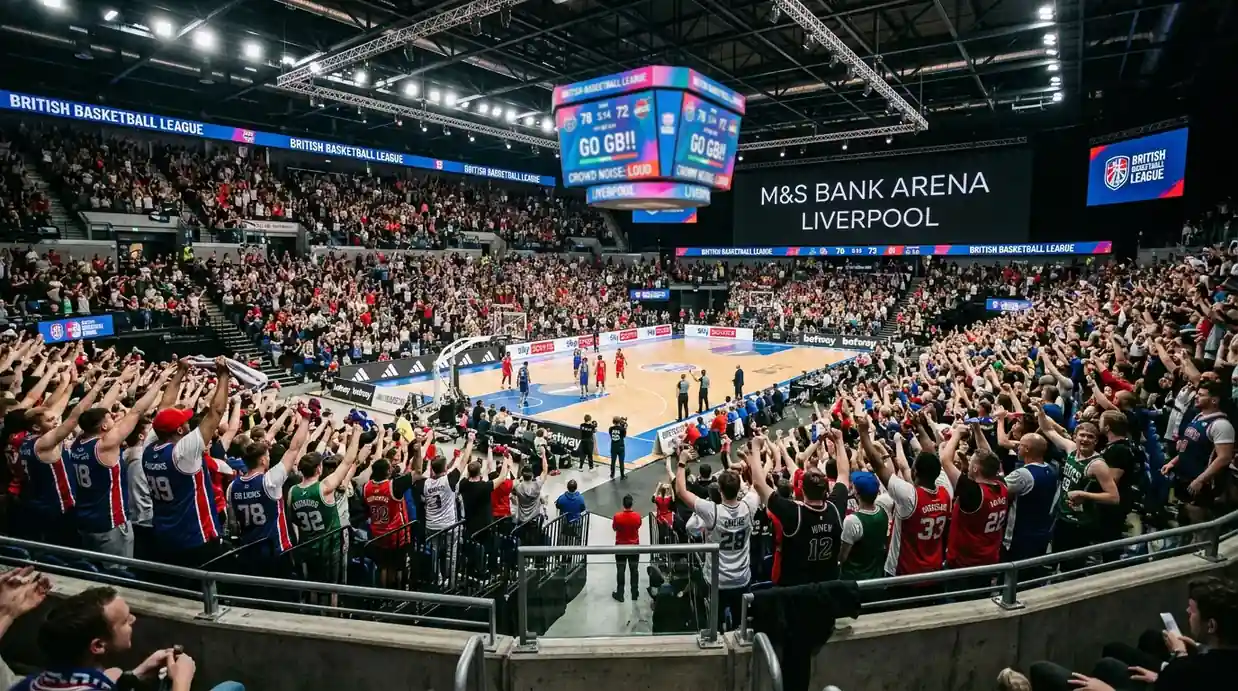
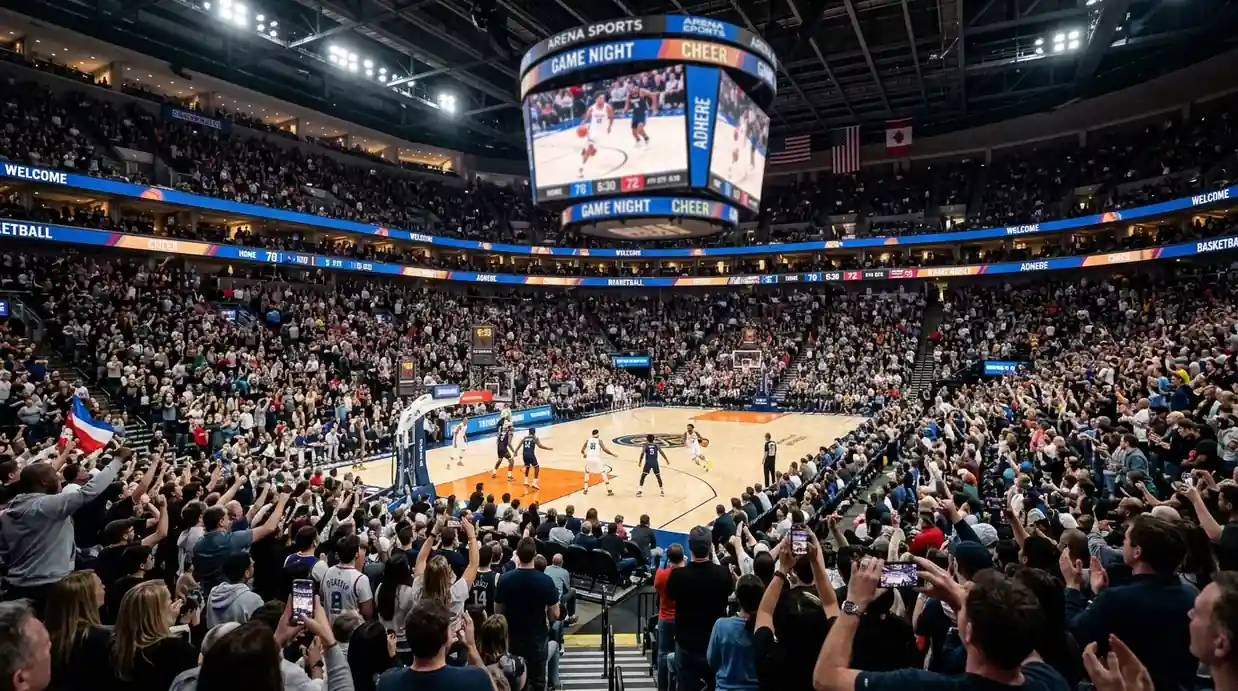
Last January, I sat courtside at the O2 Arena for the NBA London Game — Magic versus Grizzlies, the tenth regular-season match staged in the capital, a sold-out 20,000-seat arena buzzing with energy that felt nothing like your typical Premier League Saturday. That single evening crystallised something I had been tracking in the data for years: basketball is no longer a niche curiosity in Britain. It is a full-blown betting market with serious money behind it.
$124.88 billion
Global sports betting market in 2026, forecast to hit $325.71 billion by 2035
$13.92 billion
NBA market valuation in 2026, growing at 7.56% CAGR to $20.04 billion by 2031
12.6 billion pounds
UK gambling industry GGY (excluding lotteries) in FY 2024/25 — up 9.3% year-on-year
The global sports betting market stands at $124.88 billion and is projected to reach $325.71 billion by 2035 at a compound annual growth rate of 11.24%. Basketball accounts for roughly 15 to 18% of global bookmaker activity, which makes it the second or third most wagered-upon sport worldwide. The NBA alone commands a market valued at $13.92 billion, with forecasts pushing that figure past $20 billion within five years.
For UK punters, the domestic picture is equally compelling. The gambling industry pulled in GGY of 12.6 billion pounds in FY 2024/25 — a 9.3% jump from the previous year. Online sports betting specifically generated GGY of 2.6 billion pounds, with football and horse racing dominating but a growing slice flowing towards basketball and American sports.
UK online betting breakdown: Of the 2.6 billion pounds in online sports GGY, football contributes 1.3 billion pounds and horse racing 766.7 million pounds. The remaining share is split across dozens of sports — and NBA’s portion is expanding as viewership grows.
What makes this moment different from five years ago is the convergence of media rights and betting infrastructure. NBA viewership in the UK has climbed 40% since 2019, with viewers under 30 driving the sharpest increases. Basketball now ranks sixth among 18-to-24-year-olds by engagement — not yet rivalling football, but overtaking sports that have been establishment fixtures for decades. NBA Commissioner Adam Silver captured the league’s posture toward wagering when he said, “With this regulated structure of legalized betting, we can monitor it in ways that were unimaginable years ago.” That philosophy — embrace and regulate rather than prohibit — shapes everything from data partnerships to market availability.
The NBA London Game 2026 between Orlando Magic and Memphis Grizzlies became the most-watched NBA Global Game ever staged in the UK. The league has since announced a three-year European expansion: Manchester and Paris in 2027, Berlin and Paris in 2028.
The practical upshot for you as a UK bettor: the market is deep enough to offer genuine value, growing fast enough that bookmakers are still calibrating their NBA offerings, and supported by a regulatory framework that gives you protections most American bettors cannot access. Understanding that landscape is the foundation every analytical decision in this guide builds upon.
UK Legal Framework: UKGC Licensing and Your Rights
A mate of mine once asked me whether betting on basketball from England was “a bit dodgy, legally speaking.” I laughed, but it is a fair question — the sheer volume of offshore gambling adverts and unlicensed platforms can make the regulated market feel like an afterthought. It is anything but.
The UK Gambling Commission licenses and oversees every operator permitted to offer betting services to British residents. If a site accepts your wager and carries a UKGC licence, it operates under one of the strictest regulatory regimes on the planet. That licence means the operator must segregate customer funds, respond to complaints through an approved alternative dispute resolution provider, and comply with anti-money laundering requirements that are tightened almost annually.
UKGC in numbers: There are 13.5 million active online gambling accounts in the UK per month as of Q4 2024/25. Around 10% of British adults place a sports bet online or through an app within any given four-week period.
Recent regulatory changes have sharpened the consumer-protection edge considerably. Since 28 February 2025, online operators must conduct financial vulnerability checks when a customer’s net deposits reach 150 pounds within a rolling 30-day period. The threshold is deliberately low — it is designed to catch early signs of harm rather than intervene only after catastrophic losses. From 1 May 2025, operators can send direct marketing only to customers who have given explicit, product-specific consent. No more blanket email blasts pushing NBA accumulators to someone who signed up for a horse racing free bet three years ago.
Responsible gambling note: If you feel your betting is becoming difficult to control, tools like GAMSTOP (the national self-exclusion scheme) and operator-level deposit limits exist specifically for this purpose. Every licensed bookmaker is required to offer them, and they work across all products — NBA included.
One regulatory shift worth watching is the upcoming Remote Gaming Duty increase. The British government is raising the rate from 21% to 25% effective April 2027. That tax applies to operators, not to you directly — UK bettors pay zero tax on winnings. But the increased burden on bookmakers may quietly compress the margins they offer on less liquid markets, and NBA lines in the UK are exactly the kind of market where tighter margins could show up first. Adam Silver wrote back in 2014 that “sports betting should be brought out of the underground and into the sunlight where it can be appropriately monitored and regulated.” The UK took that advice long before most American states did.
Core NBA Bet Types Every UK Punter Should Know
I remember staring at a basketball betting slip for the first time and thinking it looked like someone had thrown darts at a maths textbook. Moneyline, spread, over/under, props, futures — five words, five entirely different ways to risk your money. Basketball accounts for 15 to 18% of global bookmaker activity, which means these markets are liquid, competitive, and — if you understand them — full of exploitable inefficiencies. Let me walk through each one.
Moneyline — a straight-up bet on which team wins the game, regardless of the margin. The simplest NBA wager. You pick a winner, you collect if they win.
The moneyline is where most beginners start, and for good reason. There is no spread to calculate, no total to estimate — just pick the team you think will win. The catch, naturally, is that heavy favourites return very little. A team priced at 1/5 in fractional odds (1.20 decimal) requires a 20-pound stake to earn just 4 pounds in profit. Underdogs, conversely, offer juicier payouts but win less often. The analytical challenge with moneylines is identifying spots where the implied probability embedded in the odds diverges from your assessment of the actual probability. That is where value lives, and I will get deeper into that mechanism in the NBA betting odds explained guide.
Spread (point spread / handicap) — a bet on the margin of victory. The bookmaker assigns a points advantage to the underdog, and you wager on whether the favourite wins by more than that margin or the underdog stays within it.
Spread betting is the backbone of NBA wagering in the United States and increasingly popular with UK punters. If you see “Boston Celtics -6.5,” it means the Celtics must win by 7 or more points for a spread bet on them to pay out. The .5 eliminates the possibility of a push (a tie against the spread). For UK bettors more familiar with football handicaps, the mechanics are identical — only the typical margins differ. NBA games routinely feature spreads of 8, 10, even 12 points for lopsided matchups, something almost unheard of in football. I have a full breakdown of NBA spread betting that covers ATS records, alternative lines, and practical strategy.
Over/under (totals) — a bet on the combined final score of both teams. The bookmaker sets a line, and you wager on whether the actual total will be higher (over) or lower (under) than that number.
Totals markets are where pace — the number of possessions per game — matters most. A matchup between two fast-paced teams might carry a total of 235.5, while a grind-it-out defensive affair could sit at 208.5. I find totals particularly rewarding to analyse because the data is more stable than game outcomes: a team’s pace and defensive efficiency over a 20-game sample is far more predictive than their win-loss record over the same span. If you are eyeing back-to-back games where fatigue suppresses scoring, or a high-altitude fixture in Denver where visitors historically struggle, totals give you a clean way to exploit those angles.
| Bet type | What you are predicting | Typical UK odds format | Best suited for |
|---|---|---|---|
| Moneyline | Outright winner | Fractional (e.g. 2/1) or decimal (3.00) | Strong opinions on the winner, underdog hunting |
| Spread | Margin of victory | Typically even money (-110 equivalent) | Close games, data-driven margin analysis |
| Over/under | Combined total score | Fractional or decimal at near even money | Pace-based analysis, fatigue and rest angles |
| Parlay / accumulator | Multiple selections combined | Multiplied odds | Higher-risk, higher-reward multi-game wagers |
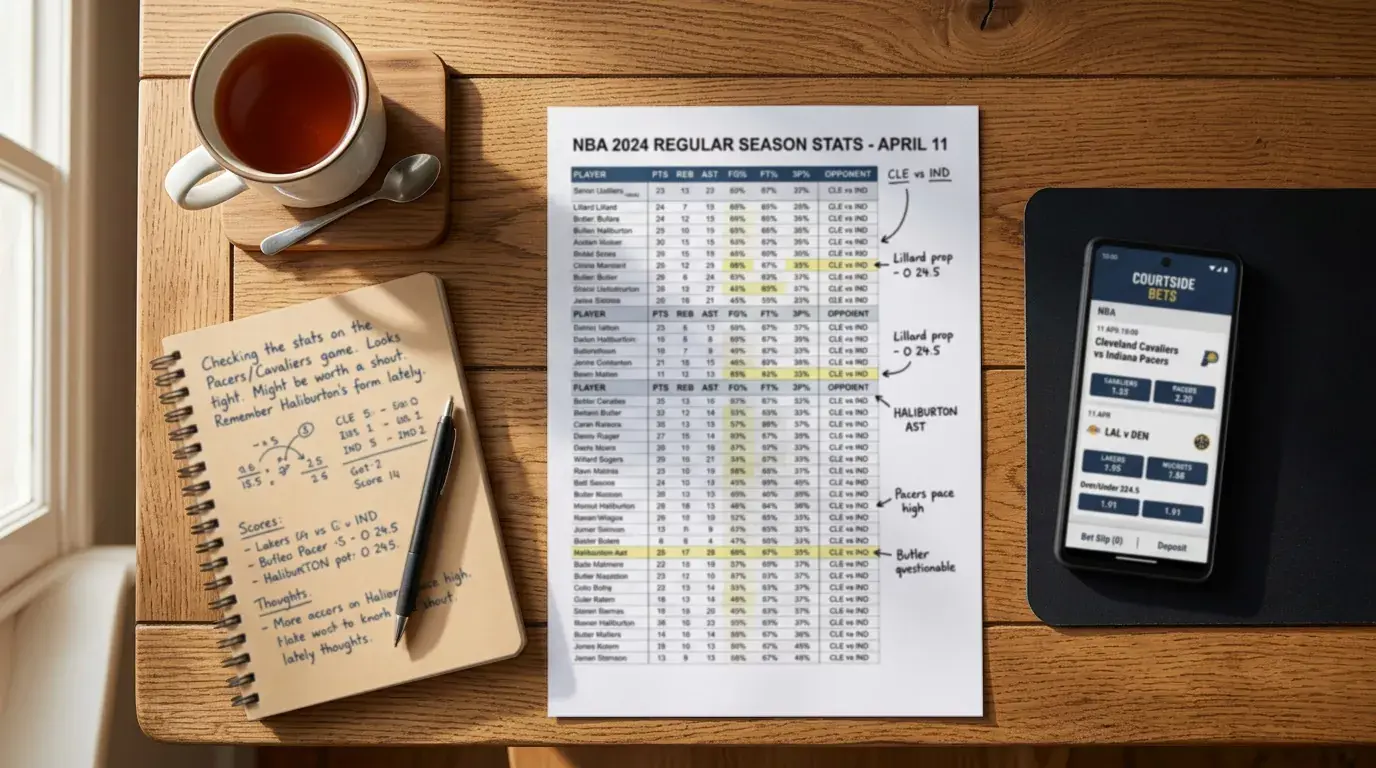
Parlay (accumulator) — a single bet combining two or more selections. All legs must win for the bet to pay out. The odds multiply, creating large potential returns from small stakes — but the mathematical reality is that every additional leg reduces your probability of winning.
Parlays are where bookmakers make their margin, and where undisciplined punters lose theirs. A three-leg accumulator at even odds has roughly a 12.5% chance of landing, but the payout rarely reflects true probability once the bookmaker’s overround is factored in. I am not saying never play accumulators — I have hit a few memorable ones myself — but treat them as entertainment, not strategy.
Quick odds comparison: Suppose a team is priced at 3/1 fractional (the UK standard). That same price in decimal format is 4.00, and in American format it is +300. A 10-pound stake returns 40 pounds total — 30 pounds profit plus your original 10 pounds back. All three formats express the same probability: 25%.
Player Props at a Glance
Player props shift the focus from the team to the individual — you are no longer betting on whether the Celtics beat the Knicks, but on whether Jayson Tatum scores over 27.5 points, or whether Jalen Brunson dishes more than 6.5 assists. These markets have exploded in popularity over the past three seasons, driven by the same younger demographic (adults 18 to 34 make up 41% of NBA engagement) that gravitates toward fantasy sports and individual player narratives.
Player prop categories: Points scored, rebounds, assists, three-pointers made, steals, blocks, and combination markets (points + rebounds + assists). UK bookmakers vary widely in their prop depth — some offer 30-plus markets per game, others only the basics.
The analytical edge in props comes from correlation awareness. If a team’s starting point guard is ruled out, the backup’s assist numbers jump — but so does the usage rate (and therefore the scoring volume) of the remaining starters. These ripple effects are where I find the most consistent value. NBA Commissioner Adam Silver has acknowledged the tension, noting that the league has asked betting partners to pull back on certain prop markets, particularly those involving underperformance by players on minor contracts. The integrity angle is real, and I cover it in a dedicated section later in this guide.
For a deeper look at prop selection strategies, correlation analysis, and which advanced statistics drive the sharpest prop edges, see the full NBA player props guide.
Futures and Outright Markets
Futures are the slow-burn bets — you stake money on an outcome that will not be settled for weeks or months. The NBA Championship winner, the MVP award, conference champions, season win totals. I think of futures as the fixed-income side of a betting portfolio: low liquidity, capital locked up for ages, but the potential for outsized returns if you identify value early enough.
Futures (outright) — a wager on a long-term outcome, typically available before and during the season. Odds shift continuously as results, injuries, and trades reshape the competitive landscape.
The NBA market’s projected growth from $13.92 billion in 2026 to $20.04 billion by 2031 is partly fuelled by the expansion of futures offerings. Pre-season championship odds are available at most UK bookmakers from September, and the lines move dramatically. A team that opens at 25/1 in October can shorten to 6/1 by February if they reel off a 15-game winning streak — or drift to 80/1 if injuries pile up. The key is understanding when and why those movements happen, which is something I unpack fully in the NBA futures betting guide.
MVP odds — a futures market on the regular-season Most Valuable Player award. Historically dominated by a small pool of elite scorers, but recent seasons have seen dark-horse candidates deliver enormous returns for early backers.
For UK bettors, futures carry one significant practical advantage: your winnings are tax-free regardless of how long the bet runs. No capital gains consideration, no reporting requirement. Place the bet in October, collect in June, and the full profit is yours.
How NBA Odds Work for UK Bettors
Here is a confession: for my first two years of NBA betting, I did not actually understand the relationship between fractional odds and implied probability. I could read the numbers — 5/1 means five pounds profit for every pound staked — but I treated them as labels rather than data points. Once I started converting every line to implied probability before placing a bet, my strike rate did not change, but my returns did. Dramatically.
UK bookmakers default to fractional odds because that is the tradition here. You will see prices like 4/7, 11/8, or 9/2 on NBA games. The first number is your potential profit; the second is the stake required to earn it. Fractional odds of 4/7 mean that for every 7 pounds you stake, you earn 4 pounds in profit — plus your 7 pounds back. The implied probability is 7 divided by (4 + 7), which gives you 63.6%. If you believe the team’s true win probability is 70%, you have found value.
Fractional to decimal conversion: Take fractional odds of 5/1. Divide 5 by 1, then add 1. That gives you decimal odds of 6.00. A 10-pound stake at 6.00 returns 60 pounds total (50 pounds profit plus 10 pounds stake). The implied probability is 1 divided by 6.00 = 16.7%.
Decimal odds, favoured across continental Europe and increasingly offered as a display option on UK sites, are cleaner for calculation. The number shows your total return per unit staked. Decimal 2.50 means a 10-pound bet returns 25 pounds. The implied probability is simply 1 divided by the decimal odds. No fractions, no mental arithmetic gymnastics. I switched to decimal display years ago and never went back — it makes comparing lines across bookmakers significantly faster.
Worked example: full stake calculation
Suppose you want to bet on a team priced at 11/8 fractional (equivalent to 2.375 decimal).
Stake: 20 pounds.
Fractional calculation: (11 / 8) x 20 = 27.50 pounds profit. Total return: 47.50 pounds.
Decimal calculation: 2.375 x 20 = 47.50 pounds total return. Profit: 47.50 – 20 = 27.50 pounds.
Implied probability: 8 / (11 + 8) = 42.1%. If your model says the team has a 50% chance, the expected value is positive.

American odds — the +150 and -200 format — are less common on UK platforms but essential to understand if you consume US-based NBA analysis. A positive number (+150) tells you the profit on a 100-dollar stake; a negative number (-200) tells you how much you need to stake to earn 100 dollars. The conversion is straightforward: +150 fractional is 3/2, decimal is 2.50.
| Format | Underdog example | Favourite example | Return on 10-pound stake |
|---|---|---|---|
| Fractional | 5/1 | 2/5 | 60 pounds / 14 pounds |
| Decimal | 6.00 | 1.40 | 60 pounds / 14 pounds |
| American | +500 | -250 | 60 pounds / 14 pounds |
UK online sports betting generates 2.6 billion pounds in GGY annually, and a meaningful chunk of that revenue comes from bettors who never convert odds to probability. The bookmaker’s overround — the margin built into both sides of a market — is invisible unless you calculate implied probabilities for all outcomes and sum them. If the total exceeds 100%, the excess is the bookmaker’s edge. On NBA markets at UK books, that overround typically runs between 4% and 7% for main markets, widening to 10% or more for exotics.
Live NBA Betting: What UK Punters Need to Know
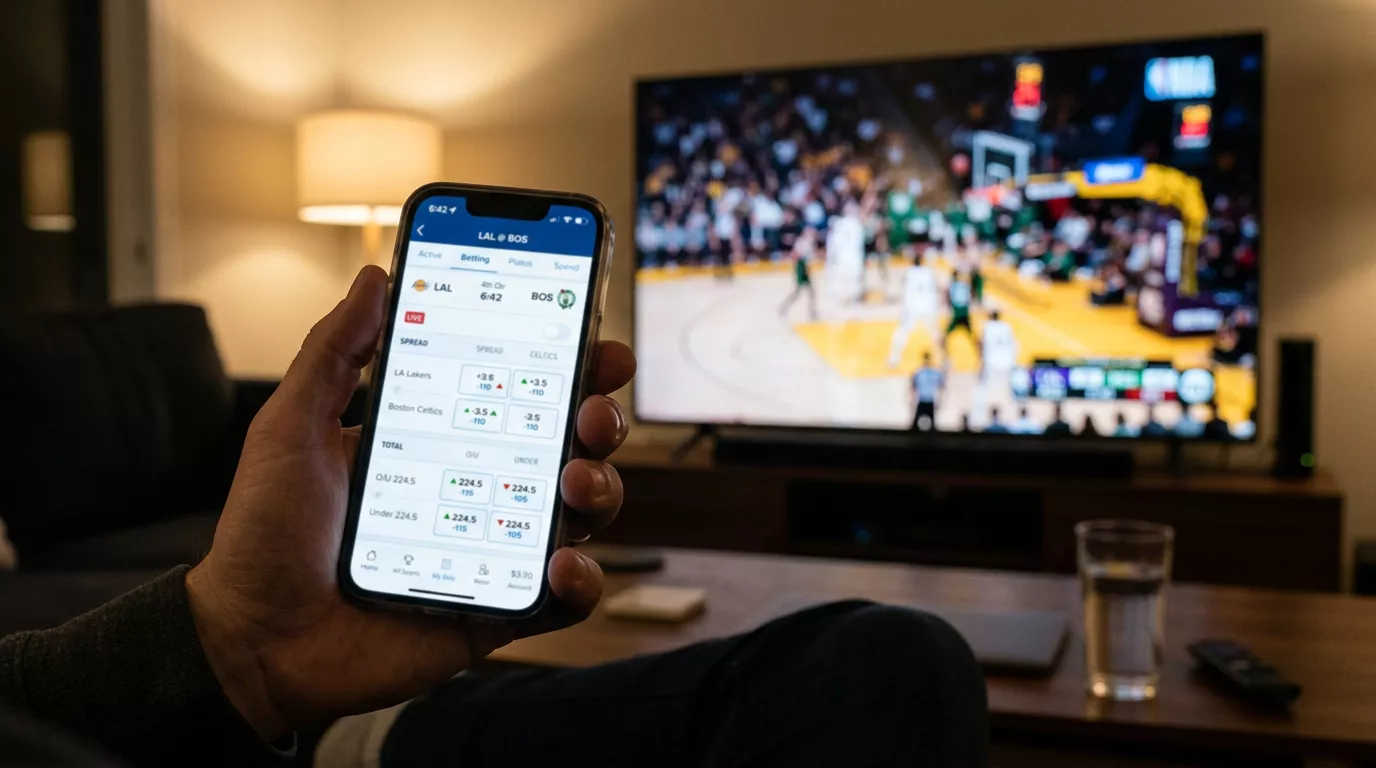
The first time I placed an in-play NBA bet, I was watching a Nuggets-Suns game on a delay. I backed Denver’s live spread after a third-quarter run, feeling clever — only to discover the line had already moved three points past my entry because the feed I was watching lagged by about 90 seconds. That lesson cost me 25 pounds and taught me something the bookmakers already knew: in live betting, information latency is everything.
62.35%
Share of US online sports betting revenue generated by live/in-play wagers in 2025, with projected growth at 13.62% CAGR through 2031
Live betting now accounts for 62.35% of online sports betting revenue in the United States, and the UK trajectory mirrors it. The appeal is obvious: rather than committing your stake before tip-off and waiting three hours, you can read the flow of the game and place wagers as the action unfolds. Quarter and half-time spreads, next team to score, live totals, and real-time player prop adjustments are all available at most UK-licensed operators.
The complication for UK punters is timing. Most NBA games tip off between 23:00 and 03:00 GMT during the regular season. The second half — where the sharpest in-play opportunities tend to appear — often falls between 01:00 and 04:00. Late-window games (01:00 and 01:30 GMT starts) offer the best balance between watchability and market depth, because American public betting volume is thinner and lines can be softer.
UK time zone note: During British Summer Time (late March to late October), NBA tip-offs shift one hour later by the clock. A game starting at 19:00 Eastern is midnight GMT but 01:00 BST. The NBA playoffs, running April to June, coincide almost entirely with BST, pushing the latest starts to 03:30 or beyond.
Former Massachusetts Governor Charles Baker observed that “the phone changed everything” — referring to how rapidly mobile betting penetrated American life after the 2018 federal legalisation. That observation applies just as squarely to UK in-play NBA betting. The ability to watch a game on one screen and adjust your positions on another, reacting to momentum shifts in real time, has fundamentally altered how the sharpest bettors approach basketball wagering. But it has also made discipline harder. The pace of NBA games — possessions every 14 seconds, scoring runs that can flip a 12-point deficit in two minutes — creates a dopamine loop that encourages impulsive stakes. I have a complete breakdown of timing strategies and momentum reading in the NBA live betting guide.
Building a Data-Driven NBA Betting Strategy
Two seasons ago I ran an experiment: I tracked every NBA spread bet I placed for four months, splitting them into two buckets. Bucket A was bets backed by at least three quantitative filters (ATS record, rest-day status, and opponent defensive rating). Bucket B was bets based on my “feel” for how a game would go. After 200 total wagers, Bucket A returned +7.3% ROI. Bucket B returned -11.6%. I do not trust my gut any more.
The foundation of any credible NBA betting strategy is a repeatable process — a checklist you run before every wager, not a vague sense that a team is “due.” Let me give you the framework I use.
Pre-bet checklist: five filters before you stake
- Check the ATS record over the last 20 games. A team covering at 60%+ over that span has momentum in the market’s eyes, not just on the court. Oklahoma City Thunder led the league with a 69-39 ATS record (64%) across the past two and a half seasons; Orlando sat at 65-42 (61%). These are the kinds of sustained edges worth tracking.
- Assess rest-day differential. If one team is on the second night of a back-to-back and the opponent has had two days off, the spread often does not fully account for the fatigue factor — particularly in totals markets.
- Review home/away context. In NBA playoff history, home teams in Game 7 situations hold a record of 115-40, a .742 win percentage. Regular-season home advantage is smaller but still measurable.
- Scan for injury and lineup news. A late scratch of a team’s primary ball-handler shifts the spread, the total, and every associated player prop. Set alerts for official injury reports, which the NBA publishes by 17:30 Eastern (22:30 GMT).
- Compare odds across at least three UK-licensed bookmakers. A half-point difference on a spread or a 0.10 shift in decimal odds compounds into serious money over hundreds of bets.
NBA’s SVP of Fantasy and Gaming, Scott Kaufman-Ross, has been consistent that the league considers official data critical to a healthy betting ecosystem — and he is right. The data infrastructure behind NBA wagering is more sophisticated than any other North American sport, and as a bettor, you should be using that infrastructure rather than fighting it. Free resources like Basketball Reference and NBA.com’s stats portal give you access to the same underlying numbers that drive bookmaker models.
Do
- Track every bet in a spreadsheet, including the closing line at tip-off. Comparing your entry price to the closing line is the single best measure of long-term betting skill.
- Specialise in one or two bet types initially. Mastering spreads alone will serve you better than dabbling across five markets simultaneously.
- Use a flat-staking approach — 1 to 2% of your bankroll per wager — until you have a verified sample of at least 300 bets.
Don’t
- Chase losses by doubling stakes after a losing night. NBA schedules cluster games on certain days, and the temptation to “make it back” on the late-window slate is a bankroll killer.
- Ignore the overround. If you are consistently betting into markets with 8%+ vig, even a sharp model will struggle to turn a profit.
- Confuse a hot streak with a validated edge. A 15-bet winning run can be pure variance. Only sustained positive CLV over 300+ bets suggests genuine skill.

Worked example: ATS analysis in practice
Tuesday night matchup. Team A is 14-6 ATS in their last 20 games and rested. Team B is 8-12 ATS and on a back-to-back. The spread is Team A -4.5.
Team A’s 70% ATS rate suggests the market is consistently undervaluing them. Team B’s fatigue factor on a back-to-back historically costs 1.5 to 2 points against the spread. You compare the -4.5 line across three bookmakers and find one offering -4.0 — that half-point of value is worth taking. You check Team B’s injury report, confirm the lineup, stake 1.5% of bankroll, and log the bet.
Advanced Metrics That Move the Needle
If I could give a new NBA bettor one piece of advice, it would be this: stop looking at points per game and start looking at efficiency. Points per game tells you how much a team scores. It tells you nothing about how efficiently they score, how many possessions they use to get there, or how well they prevent the opponent from scoring. That context is everything.
Net Rating — the difference between a team’s offensive rating (points scored per 100 possessions) and defensive rating (points allowed per 100 possessions). A team with a Net Rating of +5.0 is outscoring opponents by 5 points per 100 possessions, regardless of pace. This is the single most predictive team-level metric for betting purposes.
True Shooting percentage (TS%) adjusts for the fact that not all shots are created equal. A player who scores 25 points on 15 field goal attempts and 8 free throws is more efficient than one who scores 25 on 22 attempts and 2 free throws, even though their raw points are identical. TS% captures that difference by weighting two-point attempts, three-point attempts, and free throws appropriately. For prop bettors, TS% tells you whether a player’s scoring output is sustainable or inflated by a hot shooting night.
| Metric | What it measures | Best used for |
|---|---|---|
| Net Rating | Points differential per 100 possessions | Spread and moneyline analysis |
| True Shooting % (TS%) | Scoring efficiency across all shot types | Player points props, sustainability checks |
| Effective Field Goal % (eFG%) | Field goal percentage adjusted for three-point value | Team offence evaluation, totals |
| Pace | Possessions per 48 minutes | Over/under totals, live betting tempo reads |
Effective Field Goal percentage (eFG%) is similar to TS% but excludes free throws. It answers a narrower question: how efficiently does a team or player convert field goal attempts? A team with a high eFG% and a fast pace is a strong over candidate. A team with a low eFG% and a slow pace is a strong under candidate. The interplay between these two metrics is where I find the cleanest totals edges.
Built on the metrics your guide champions: pace sets the number of possessions, offensive and defensive rating (the two halves of Net Rating) set the efficiency, and about 2.2 points of home-court edge is added. „Fair odds” carry no bookmaker margin — compare them with the book’s line. Net Rating is the single most predictive team-level number for spreads and moneylines; pace and eFG% drive the cleanest totals edges. Informational only.
The projection nudges the player’s season average by your matchup adjustment — raise it for a fast pace or a soft defensive assignment, lower it for a lockdown defender, a back-to-back or reduced minutes. Probabilities use a bell curve around the projection with a spread that fits each stat type. Remember correlation: if a team’s primary ball-handler is out, the backup’s assists and the remaining starters’ usage both jump. Informational only.
Sportradar paid more than $1 billion for an eight-year exclusive contract to distribute NBA data to betting operators worldwide — a deal that gave the NBA a 3% equity stake in the company. That investment tells you everything about how valuable granular, real-time data has become. As a bettor, you can access the same underlying statistics for free through Basketball Reference and NBA.com’s stats portal; what you are paying for through the vig is speed and structure.
Integrity and Fair Play: What the Data Tells Us
In October 2025, the FBI arrested more than 30 people in connection with an illegal gambling ring that reached into the NBA itself. Among those charged were Miami Heat guard Terry Rozier and Trail Blazers coach Chauncey Billups. The case was not subtle: $263,000 was wagered on Rozier in a single day — a spike so obvious that bookmakers flagged it immediately. If there is a single story that illustrates both the risk and the resilience of the modern betting market, it is this one.
Integrity matters for your bets: Suspicious activity at the player or official level can distort lines, inflate prop odds, and create false value signals. Understanding the integrity landscape is not paranoia — it is due diligence.
The Rozier case followed the 2024 Jontay Porter scandal, which prompted the NBA to ask its betting partners to stop offering prop bets on underperformance by players on two-way contracts. Porter, a fringe roster player, had manipulated his own minutes and stats to influence prop markets — a vulnerability the league acknowledged and moved to close. Commissioner Adam Silver has been unequivocal: “There’s nothing more important to the league and its fans than the integrity of the competition.”
The $263,000 wagered on Terry Rozier in a single day was detected and flagged by bookmakers’ automated monitoring systems almost in real time — a demonstration of how quickly modern surveillance catches anomalous patterns.
For UK bettors, the practical implications are twofold. First, prop markets on lower-profile players are inherently riskier not just in terms of variance but in terms of integrity. If you are betting on whether a two-way contract player hits 8.5 points, you are operating in a market that the NBA itself has identified as vulnerable. Second, the monitoring infrastructure is genuinely robust. Sportradar’s data feed powers integrity alerts for leagues and regulators worldwide, and UK-licensed bookmakers are required by the Gambling Commission to report suspicious betting patterns. The system is not perfect — no system involving human incentives ever is — but it is far more sophisticated than most casual bettors assume.
I do not shy away from prop markets, but I concentrate my prop bets on established starters with high minutes floors and transparent usage patterns. The further you move down a roster, the more you rely on variables you cannot observe — and the closer you get to where integrity concerns live.
Watching and Betting on NBA Games from the UK
You cannot bet intelligently on a sport you do not watch. That sounds obvious, but I know plenty of punters who build NBA models from box scores without ever seeing the teams play. They miss the things numbers do not capture: a coach’s fourth-quarter rotation preferences, a team’s body language during a road back-to-back, the way an arena’s atmosphere tilts officiating in tight games. Watching the games is part of the work.
UK broadcast landscape: In late 2025, the NBA signed a new partnership with Amazon Prime Video that dramatically expanded the league’s UK reach. Sky Sports continues to carry select games. NBA League Pass remains available for comprehensive coverage, offering every game on demand with condensed replays.
The Amazon deal was a turning point. Before it, watching NBA in the UK required either a League Pass subscription or a Sky Sports package. Now, a significant portion of the schedule is accessible to anyone with an Amazon Prime membership, which millions of UK households already have. The result has been a visible acceleration of the audience growth trend that was already underway, particularly among the under-30 demographic.

The NBA London Game 2026 at the O2 Arena — Orlando Magic vs Memphis Grizzlies — was a record-breaking sold-out event with 20,000 fans, making it the most-watched NBA Global Game ever staged in the UK. The league has committed to a three-year European schedule that includes Manchester in 2027.
Alex Hill, President and CEO of AEG International, which operates the O2, described the venue as “renowned for hosting some of the world’s premier sporting events” — and the NBA’s decision to make London a recurring fixture on the calendar validates the UK market’s importance to the league’s global strategy.
For betting purposes, the broadcast schedule directly affects your analytical workflow. Games carried on Amazon Prime or Sky typically feature higher-profile matchups with deeper market liquidity. Thursday and Saturday slates tend to have the best UK-friendly tip-off times (a 00:00 or 00:30 GMT start lets you watch the full game and still function the next morning). I plan my weekly betting around the broadcast schedule as much as the statistical matchups, because being able to watch a game live while holding an in-play position is a material advantage over betting blind.
Your First NBA Bet: A Step-by-Step Walkthrough
Theory is useful. Actually placing a bet is where the theory meets friction — unfamiliar interfaces, unexpected verification requests, and the mild panic of watching real money leave your account for the first time. Let me walk you through the entire process from zero.
Seven steps from sign-up to settled bet
- Choose a UKGC-licensed bookmaker that offers NBA markets. Check that the operator lists its licence number in the website footer — every legitimate UK operator does. Open an account and complete identity verification, which typically requires a photo ID and a proof of address.
- Deposit funds using your preferred payment method. Be aware that since February 2025, operators must run a financial vulnerability check if your net deposits hit 150 pounds within 30 days. This is a regulatory protection, not a red flag — expect it and cooperate with it.
- Navigate to the basketball or NBA section. On most platforms, NBA sits under “Basketball” in the sports menu. Select the game you want to bet on.
- Choose your market. For a first bet, I recommend a simple moneyline or spread wager on a game you plan to watch. Avoid parlays and exotics until you have a feel for how single bets settle.
- Enter your stake. I suggest starting with the minimum — typically one or two pounds. The goal of your first bet is process familiarity, not profit. You are learning the interface, not trying to fund a holiday.
- Review the bet slip. Confirm the selection, the odds (check whether you are viewing fractional or decimal — switch to your preferred format in the settings), and the potential return. Then place the bet.
- Watch the game and track the result. After the game ends, the bet should settle within minutes. Check your account balance, note the outcome in your tracking spreadsheet, and review whether the closing line moved from where you entered. That closing-line comparison is your first data point in building a long-term record.
The entire process takes about 15 minutes for account setup and 2 minutes for the bet itself once you know the interface. Do not leave the verification step to the night you want to bet — some operators take 24 to 48 hours to approve documents.
Worked example: your first spread bet
You deposit 50 pounds. Tonight’s featured game shows Team A -5.5 at odds of 10/11 fractional (1.91 decimal). You stake 5 pounds on Team A -5.5.
If Team A wins by 6 or more: return is 5 x 1.91 = 9.55 pounds (profit of 4.55 pounds). If they win by 5 or fewer, or lose, you forfeit the 5-pound stake.
After the game, you log everything: date, market, entry odds, closing odds, result, profit/loss. That log is the raw material for every strategic improvement that follows.
Responsible gambling reminder: Around 10% of UK adults bet on sports online in any given month. If you are joining that group, set a deposit limit and a loss limit before you place your first wager. Every UKGC-licensed operator is required to offer these tools, and using them from day one builds a healthy habit that protects your bankroll and your wellbeing. The upcoming Remote Gaming Duty increase to 25% in April 2027 is the government’s problem, not yours — your winnings remain completely tax-free.
Frequently Asked Questions
How do NBA betting odds work in the UK?
UK bookmakers display NBA odds primarily in fractional format (e.g. 5/2), though most platforms let you switch to decimal or American in your settings. The odds represent both the potential payout and the implied probability assigned to an outcome. To find implied probability from fractional odds, divide the denominator by the sum of numerator and denominator — so 5/2 gives you 2 / (5+2) = 28.6%. Comparing that implied probability to your own assessment is how you identify value.
What are the most popular types of NBA bets?
The four core markets are moneyline (picking the outright winner), spread or handicap (margin of victory), over/under or totals (combined final score), and player props (individual statistical outcomes like points, rebounds, or assists). Parlays or accumulators combine multiple selections but carry significantly higher risk due to compounding probability.
Is NBA betting legal in the UK?
Yes. Betting on NBA games is fully legal through operators licensed by the UK Gambling Commission. Licensed operators must meet strict standards for consumer protection and fund segregation. Your winnings are tax-free — the tax burden falls on the operator through Remote Gaming Duty. Always verify that a bookmaker holds a UKGC licence before depositing funds.
What is spread betting in the NBA?
Spread betting involves wagering on the margin of victory rather than the outright winner. The bookmaker sets a point spread — for example, Team A -6.5 — meaning Team A must win by 7 or more points for a bet on them to pay out. If you back the underdog at +6.5, they can lose by up to 6 points and your bet still wins. The concept is identical to football handicap betting, though NBA spreads tend to be larger due to basketball’s higher-scoring nature.
How do I bet on NBA player props?
Player props are available under individual game markets at most UK bookmakers. Select a statistical category — points, rebounds, assists, three-pointers — and wager on whether the player goes over or under the bookmaker’s line. The key is researching recent form, usage rate, and the opposing team’s defensive profile. Prop market depth varies across UK platforms, so compare availability before committing.
What is a same game parlay (bet builder) in NBA?
A same game parlay, often called a bet builder at UK bookmakers, combines multiple selections from the same game into one wager. You might combine a team spread, a game total, and a player prop. The odds multiply for a larger potential payout, but all legs must win. The analytical challenge is understanding correlation — backing a team to win big and the total to go under are positively correlated, because blowouts reduce late-game intensity.
When is the best time to bet on NBA games from the UK?
For pre-game bets, the window between the official NBA injury report (published by 17:30 Eastern, 22:30 GMT) and tip-off is when the sharpest line movements occur. For live betting, the third quarter often offers the widest value swings as bookmakers recalibrate after half-time adjustments. Mid-week slates with fewer games tend to have sharper lines, while Saturday nights with 10-plus games can produce softer markets.
Created by the ”nba Game Betting” editorial team.