NBA Live Betting: In-Play Markets, Timing Strategies and UK Time Zone Tips
 Available in US
In-play betting now accounts for over 62% of online sports betting revenue in the United States, and that number is still climbing. The NBA — with its constant scoring, frequent momentum swings and two-and-a-half-hour runtime — is the sport built most naturally for live wagering. Every timeout is a pricing reset. Every substitution is a market shift. Every run of 8 unanswered points sends the live spread lurching in a new direction.
For UK punters, live NBA betting comes with a unique logistical challenge: time zones. Most games tip off between 11pm and 3am GMT, which means you are making decisions while much of the country sleeps. That constraint can be an advantage if you treat it strategically, or a disaster if you treat it casually — betting tired, betting bored, betting because you are still awake and the market is open.
I have been trading NBA live markets from London for the best part of eight years. The lessons have not always been cheap. This guide covers the markets available, the timing strategies that work from this side of the Atlantic, and the discipline framework that keeps live betting profitable instead of just exciting.
Table of Contents
- NBA In-Play Markets Available to UK Bettors
- Quarter and Half-Time Markets During Live Play
- Reading Momentum Shifts for Live NBA Bets
- UK Time Zones and the NBA Live Betting Window
- Data Latency and Official Feeds: What Moves Live Lines
- Cash-Out Features and Partial Hedging
- Staying Disciplined During Live NBA Betting
- Frequently Asked Questions
NBA In-Play Markets Available to UK Bettors
The range of live NBA markets at UK sportsbooks has expanded enormously over the past three years. Five years ago, you were lucky to get a live moneyline and a live spread. Today, the best UK operators offer a full suite during tip-off-to-buzzer windows: live moneyline, live spread, live total, next team to score, live player props and — on marquee games — live quarter and half-time markets.
Live moneyline is the simplest: which team wins from this point forward. The odds adjust after every significant play — baskets, turnovers, fouls — and reflect the current score, time remaining and pre-game assessments of team strength. If the Celtics were -300 pre-game favourites and they trail by 8 at half-time, the live moneyline might shift to something near pick’em, offering a price on Boston that was unavailable before the game started.
Live spread mirrors the pre-game spread concept but recalibrates continuously. The in-play spread factors in the current margin, the pace of the game so far and the expected scoring rate for the remainder. A pre-game spread of -7.5 on Boston might become -3.5 at half-time if Boston leads by only 2, or -11.5 if they lead by 18. The bookmaker is essentially asking: “From here, who covers the rest-of-game margin?”
Live totals work the same way. If the pre-game total was 222.5 and the first quarter produces 62 combined points, the live total for the full game adjusts upward — perhaps to 230 or 232 — because the pace has exceeded the pre-game projection. Conversely, a grinding, defensive first quarter that produces only 42 combined points pulls the live total down.
The UK sports betting market generates roughly 2.6 billion pounds in annual gross gaming yield, and the live segment’s share is growing faster than any other category. Bookmakers are investing heavily in live NBA coverage because the engagement metrics — bets per session, session duration, handle per user — are significantly higher for in-play bettors than for pre-game-only customers. That investment means more markets, faster updates and tighter margins on live lines, all of which benefit the informed UK punter.
Quarter and Half-Time Markets During Live Play
Quarter and half-time markets during live play are where I have found some of my sharpest edges — and where the bookmaker’s pricing model is most stretched. These are period-specific bets offered while the game is in progress, distinct from the pre-game period markets that settle at fixed intervals.
A live second-quarter spread, for example, opens at the start of the second period and settles when the second quarter ends. The bookmaker prices it using the first-quarter performance as a baseline, blending that with pre-game expectations. If the first quarter was a defensive slugfest — say 21-18 — the live second-quarter total might be set lower than the pre-game projection, even though the historical pattern shows NBA teams often loosen up offensively in the second quarter after tight opening periods.
Half-time markets operate similarly. A live second-half spread opens at the break and asks: who covers the margin for the final 24 minutes? These are particularly interesting because coaches make their biggest tactical adjustments at half-time, and those adjustments are not fully reflected in the bookmaker’s second-half line. A team that was getting carved up by pick-and-roll in the first half might switch to zone defence after the break, fundamentally altering the scoring dynamic in ways the live pricing algorithm underweights.
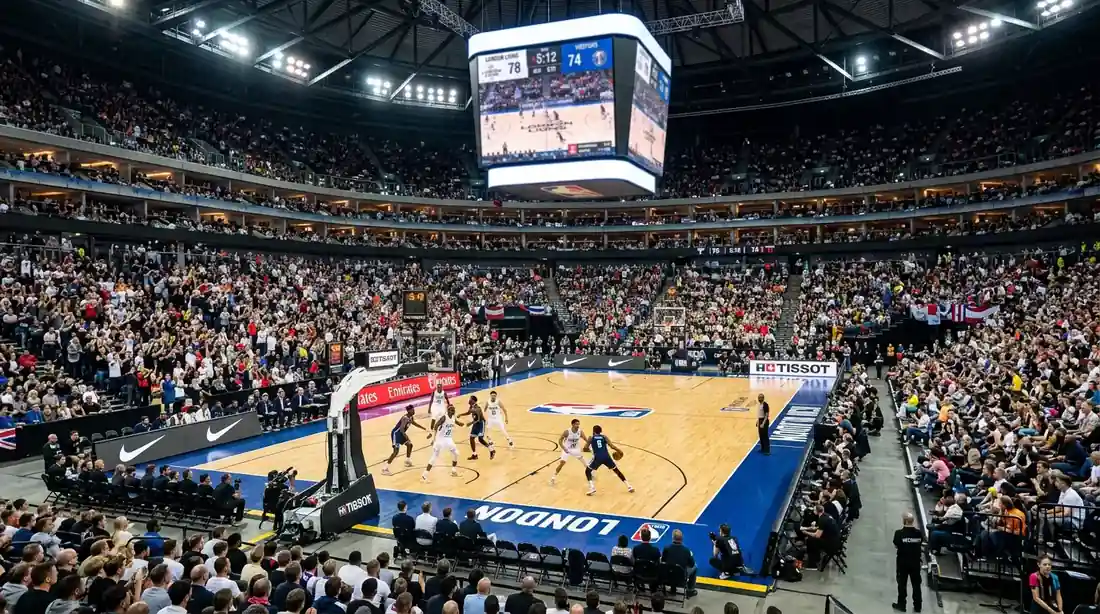
Coverage varies by bookmaker and by game. High-profile matchups — nationally televised US games, playoff contests, the NBA London Game — get full live period markets. A Tuesday night game between two mid-table Western Conference teams might only carry a live full-game moneyline and spread. If period markets are part of your strategy, check availability before tip-off and have backup options across multiple sportsbook accounts. For a comprehensive breakdown of period-market strategies including pre-game approaches, the NBA betting calendar guide maps the best windows for these markets across the season.
Reading Momentum Shifts for Live NBA Bets
Here is a scenario I have lived through dozens of times: the Nuggets trail by 14 midway through the third quarter, the live spread balloons to +10.5, and then Jokic orchestrates a 16-2 run that flips the game entirely. If you spotted the run building — a couple of turnovers forced, a transition dunk, the opposing coach burning a timeout — and backed the Nuggets at +10.5 before the run materialised in the scoreline, you captured enormous value. If you waited until the run was visible on the scoreboard, the line had already moved.
Momentum in the NBA is real but brief. Academic research and my own tracking suggest that scoring runs of 8 or more unanswered points occur multiple times per game, and the team that just completed a run is statistically no more likely to continue scoring than the opponent is. The run resets the equilibrium; it does not predict the future. What it does is create a temporary mispricing in the live market, because the algorithm adjusts to recent scoring pace faster than the underlying probability changes.
Home teams in NBA playoff games carry a documented historical advantage — Game 7s at home produce a win rate near 74% — and that home crowd factor amplifies momentum effects. A home run of 10 points in a playoff game feels different to the players, the coaches and the bookmaker’s model. The noise, the energy, the referee psychology — these variables are hard to quantify but real enough that I give a small additional weight to home-team momentum runs in playoff live betting.
The practical skill is learning to watch the game rather than the odds. If you are staring at the live line waiting for it to move before you bet, you are reacting to price rather than to events. The edge in live NBA betting belongs to the punter who sees the defensive adjustment, notices the backup point guard struggling with the ball, recognises the matchup switch that opens up the paint — and then checks the live line to see whether the market has caught up. More often than you would expect, it has not.
UK Time Zones and the NBA Live Betting Window
Charles Baker, the former governor of Massachusetts, put it bluntly when reflecting on how quickly mobile sports betting consumed American life after legalisation in 2018: the phone changed everything, and nobody anticipated how fast betting would end up in the palm of your hand. For UK punters, the phone is the same — but the clock is different, and that difference shapes your entire live betting strategy.
The NBA’s regular-season schedule features three main tip-off windows in US time. The early evening slate starts at 7pm Eastern, which is midnight GMT. The main slate tips off between 7:30pm and 8pm Eastern — 12:30am to 1am in London. And the West Coast games start at 10pm or 10:30pm Eastern, meaning 3am to 3:30am GMT. During British Summer Time, subtract an hour from all of those.
This schedule creates a natural filter. If you have a normal job and need to be functional by 8am, you realistically have access to the early and main slates — roughly midnight to 2:30am. That gives you four to six games per evening, which is more than enough for a disciplined live bettor. The West Coast games, tipping off at 3am, are for the committed night owl or the weekend warrior.
I have experimented with every scheduling approach over the years and settled on a routine that works. I do my pre-game research during the evening, between 7pm and 10pm, while the lines are still relatively stable. I set alarms for specific games where I have identified live betting opportunities — maybe a back-to-back team I expect to fade in the third quarter, or a pace mismatch I want to exploit on live totals. I watch those targeted games from midnight, place my bets within the first and third quarters where my edge is strongest, and close the apps by 2am regardless of what is happening on court.
Amazon Prime Video’s new NBA broadcast deal has made watching games from the UK significantly easier, with regular coverage and on-demand highlights that let you follow the action without needing a specialist US subscription. That accessibility feeds directly into the live betting ecosystem — you cannot bet effectively on a game you cannot watch, and the streaming infrastructure is now robust enough to support real-time wagering from a London living room.
Data Latency and Official Feeds: What Moves Live Lines
Every live NBA line you see on your sportsbook app is the output of a data pipeline that starts courtside and ends on your screen in a matter of seconds. Understanding that pipeline — and where it introduces lag — gives you a structural advantage over punters who treat live odds as instantaneous truth.
The NBA’s official data partner, Sportradar, holds an exclusive eight-year distribution contract worth over one billion dollars, running through 2031. Sportradar’s courtside operators log every play in real time — made baskets, missed shots, fouls, substitutions, timeouts — and feed that data to bookmakers via API. The bookmaker’s pricing engine ingests the feed, recalculates probabilities and pushes updated odds to the app. The entire cycle, from courtside event to updated odds on your screen, typically takes between 2 and 6 seconds.
That 2-to-6-second window is the latency gap. If you are watching the game on a live broadcast — which itself runs on a 5-to-15-second delay depending on the platform — you are actually behind the data feed. The bookmaker knows about the basket before you see it on your television. This is why betting purely by watching the broadcast puts you at a structural disadvantage: you are reacting to events the bookmaker has already priced.
The workaround is to bet on patterns rather than events. Instead of reacting to a specific basket or turnover, I build a thesis about what will happen over the next five minutes based on the game’s structural dynamics: lineup matchups, foul trouble, pace trends. Those structural factors do not change with a single possession, so the latency gap matters less. The punter who bets on “this team’s backup point guard will struggle against this defensive scheme for the next three minutes” is operating on a different timescale from the punter who bets on “that three-pointer just went in, the live line looks off.”
One more variable: not all bookmakers receive the same data feed at the same speed. Operators with direct Sportradar contracts get the fastest updates. Smaller operators that license data through intermediaries may lag by an additional second or two. That asymmetry creates brief windows where one bookmaker’s live line has not yet adjusted to an event that another bookmaker has already priced. Exploiting those windows — a practice sometimes called “latency arbitrage” — is technically possible but requires multiple accounts, fast execution and a tolerance for the ethical grey area it inhabits.
Cash-Out Features and Partial Hedging
Cash-out is the feature UK bookmakers promote most aggressively during live NBA games, and for good reason — it generates enormous revenue for the operator. Every cash-out offer includes a margin that is worse than the equivalent live odds, meaning the bookmaker profits whenever you use it. That does not make cash-out useless, but it means you need to understand when the feature serves you and when it serves the house.
The UK gambling industry recorded 12.6 billion pounds in gross gaming yield for the 2024/25 financial year, and cash-out fees are embedded within that figure as a significant revenue stream for online operators. When you cash out, the sportsbook is essentially offering to buy back your bet at a price that reflects the current live odds minus a commission. That commission is typically between 3% and 8% of the cash-out value, though it varies by operator and by market.
I use cash-out in exactly two scenarios. The first is hedging a futures bet or an accumulator where one leg remains and I want to lock in a guaranteed profit regardless of the final outcome. If I have a four-leg NBA parlay and three legs have won, cashing out before the fourth leg settles can be rational — especially if the fourth game has taken a turn that undermines my original thesis.
The second scenario is cutting losses on a live bet where new information has fundamentally changed the picture. If I bet the over on a game total at 224.5 and the starting centre picks up his fourth foul midway through the second quarter, the pace and scoring dynamic of the game has shifted materially. Cashing out at a loss might be smarter than riding a bet whose premise no longer holds.
Outside those two situations, I leave cash-out alone. The psychological pull is strong — watching a live bet fluctuate between profit and loss creates anxiety, and hitting the green cash-out button feels like control. But mathematically, frequent cash-out usage bleeds value because you are repeatedly paying the operator’s embedded margin. Discipline means accepting volatility during the game and trusting your pre-bet analysis to settle profitably over a large sample.
Staying Disciplined During Live NBA Betting
The most dangerous moment in live NBA betting is not when you are losing. It is when you are winning and the adrenaline convinces you that your judgment is sharper than it actually is. I have watched otherwise rational people turn a profitable evening into a loss by placing four impulsive bets in the final quarter of a game they had no thesis on, simply because they were riding a high from earlier wins.
About 10% of adults in the UK place a sports bet online at least once a month, and the subset who bet live on NBA games is smaller but disproportionately engaged. Live betting is designed to maximise engagement — the constant odds updates, the cash-out notifications, the one-tap bet placement — and engagement without discipline is a reliable path to negative returns.
My personal framework has four rules. First, I set a maximum number of live bets per evening: three. Not three per game — three total, across all games. This forces me to be selective and eliminates the “one more” impulse that compounds into overexposure. Second, I never place a live bet within 30 seconds of a significant play — a dunk, a turnover, a controversial foul. Emotional reactions to exciting plays produce bets that feel right but lack analytical foundation.
Third, I impose a hard stop time. Regardless of how the night is going, I close every sportsbook app at 2am on weeknights. Fatigue degrades decision-making in measurable ways, and the games tipping off after 2am are the ones where my analysis is thinnest and my impulse control is weakest. Fourth, I review every live bet the following day with fresh eyes, grading each one as either “thesis-driven” or “impulse.” If more than one bet in a week falls into the impulse category, I skip live betting entirely the following week as a reset.
Live NBA betting from the UK is genuinely exciting. The markets are deep, the action is relentless and the edges are real for a prepared punter. But the same features that make it exciting — speed, volatility, constant opportunity — are the features that exploit poor discipline. Treat the clock, the stake limit and the session cap as non-negotiable infrastructure, and the excitement becomes sustainable rather than destructive.
Frequently Asked Questions
What time do most NBA games tip off in UK hours?
The majority of NBA games fall into three windows when converted to GMT: the early slate tips off around midnight, the main slate between 12:30am and 1:00am, and the West Coast games at approximately 3:00am to 3:30am. During British Summer Time, all times shift one hour earlier. Weekday schedules tend to have fewer early games, while weekends and holidays often feature earlier tip-offs starting as early as 10:30pm GMT.
Can I watch NBA games live while placing in-play bets from the UK?
Yes. Amazon Prime Video now carries regular NBA coverage in the UK as part of its broadcast deal with the league, and Sky Sports airs select games throughout the season. NBA League Pass is also available for UK subscribers and offers the broadest game selection. Be aware that all broadcast streams carry a delay of 5 to 15 seconds compared to the real-time data feeds that bookmakers use, so the odds may update slightly before you see the corresponding play on screen.
How fast do NBA live odds update at UK bookmakers?
Live odds typically update within 2 to 6 seconds of each significant on-court event, depending on the bookmaker’s data feed. Operators with direct contracts from official data providers like Sportradar receive updates fastest. During dead-ball situations such as free throws and timeouts, the updates are near-instant because the data pipeline has time to synchronise. During fast-paced sequences with rapid possessions, there may be brief moments where the live odds lag behind the actual game state.
Published by the nba Game Betting team.