
NBA Fractional and Decimal Odds: A UK Bettor’s Conversion Guide
 Available in US
I spent my first six months betting on NBA games using whatever odds format the bookmaker displayed by default. Half the time it was decimal, the other half fractional, and I never bothered converting between them. Then I missed a value bet on a Lakers game because I could not instantly tell whether 11/8 was better than 2.30. That fumble cost me about forty quid in expected value, and it was the last time I treated odds formats as a cosmetic preference rather than a core skill.
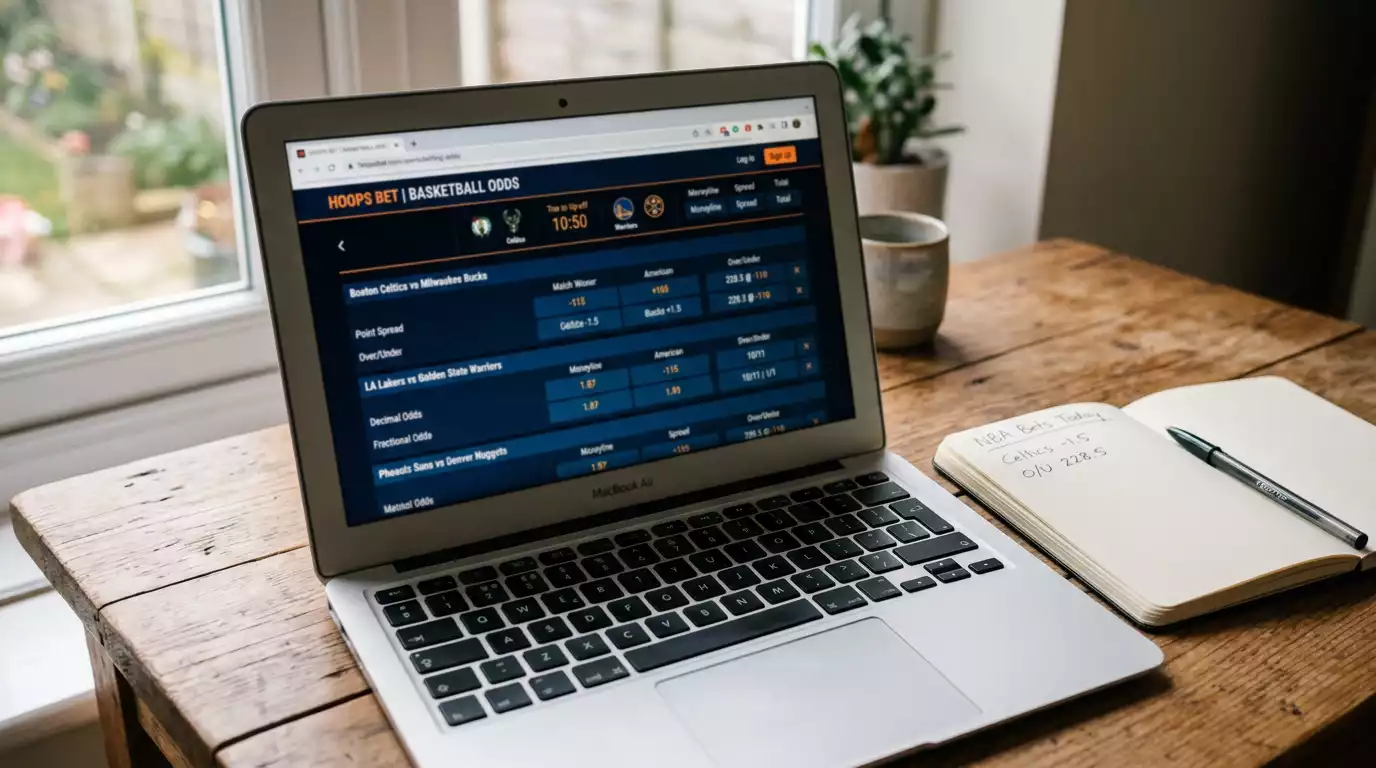
If you are betting on NBA games from the UK, you live at the intersection of three odds worlds. British bookmakers default to fractional. European platforms favour decimal. American sources — where most NBA analysis originates — use moneyline notation. Being fluent in all three is not optional; it is the price of entry for anyone serious about finding value across multiple operators. About 10% of UK adults bet on sports online in any given month, and most of them never look beyond the default display. That is an advantage for anyone willing to flip a few mental switches.
This guide is not a maths lecture. I want to give you practical conversion tools that work in your head, at the bookmaker, in real time — no calculator required for the most common NBA lines.
Fractional Odds in Practice: NBA Examples
Last January I was watching the NBA London Game at a pub near Waterloo, and the bloke next to me asked what 5/2 meant. I told him: for every two pounds you risk, you win five. He nodded, placed the bet, and it hit. He still did not understand the maths — but he understood the relationship, and that is actually the right starting point.
Fractional odds express profit relative to stake. The number on the left is your profit; the number on the right is your stake. At 5/2, a ten-pound bet returns thirty-five pounds total — twenty-five profit plus your ten-pound stake back. At 1/3, a ten-pound bet returns 13.33 pounds total — 3.33 profit plus your tenner. The fraction tells you the ratio of profit to risk, nothing more.
Where fractional odds get genuinely useful for NBA betting is in quickly gauging implied probability. Any fraction where the left number is smaller than the right — 1/2, 2/5, 4/9 — indicates an odds-on favourite. The team is expected to win more often than not. Any fraction where the left exceeds the right — 6/4, 9/2, 7/1 — signals an underdog. The bigger the gap, the less likely the outcome according to the market.
Here are the fractional prices you will encounter most frequently on NBA moneylines at UK bookmakers: 1/5 and 1/6 for heavy favourites in mismatched games; 4/7 to 8/11 for moderate favourites; 5/6 to evens for tight matchups; 6/5 to 7/4 for slight underdogs; 3/1 to 5/1 for clear underdogs; and 8/1 or longer for heavy underdogs. Burning these ranges into memory lets you assess any NBA line at a glance without reaching for a calculator.
One quirk of fractional display: some UK bookmakers simplify fractions while others do not. You might see 5/4 at one operator and 10/8 at another. They mean exactly the same thing, but the visual difference can slow your comparison. I always mentally reduce the fraction before comparing — 10/8 becomes 5/4 — and it saves a surprising amount of time across a full slate of games.
Decimal Odds and the European Betting Standard
When I started using betting exchanges alongside traditional bookmakers, I was forced to think in decimal. Exchanges display everything in decimal format because it strips away ambiguity — the number you see is exactly what you receive per pound staked, including your stake. Europe holds more than 56% of the global online gambling revenue, and the exchanges that dominate that market made decimal the lingua franca of professional betting.
Converting in your head is straightforward once you know the trick. Take the fractional odds, divide the left number by the right, and add one. So 5/2 becomes (5 / 2) + 1 = 3.50. The number 3.50 means a one-pound bet returns 3.50 pounds — 2.50 profit plus your pound back. Evens (1/1) becomes 2.00. A price of 1/4 becomes 1.25.
Decimal odds make comparison across bookmakers faster because every price is a single number. Is 3.40 better than 3.35? Obviously. Is 17/5 better than 10/3? That requires mental arithmetic. When you are line-shopping across four or five UK operators at midnight trying to get the best price on a Lakers-Celtics game tipping off in ten minutes, decimal wins on speed every time.
The one area where decimal can mislead is at very short prices. A decimal price of 1.08 looks like “barely anything” until you realise the implied probability is 92.6% and you are risking twelve pounds fifty to win one pound. At those extremes, fractional format — 2/25 — makes the risk-reward ratio more visceral. I use decimal for comparison and fractional for gut-checking whether a price is actually worth the risk.
Quick-Reference Conversion Table for Common NBA Lines
FanDuel’s Christian Genetski once described comprehensive data as a critical element to a successful customer experience — and that principle extends to something as basic as reading your own odds correctly. The table below covers the NBA lines you will see most often at UK bookmakers. I have arranged them by implied probability from highest to lowest, which is the way I actually think about prices when scanning a full night of games.
At an implied probability of 90.9%, you are looking at 1/10 fractional, 1.10 decimal, or -1000 American. Drop to 80% and the fractional reads 1/4, decimal 1.25, American -400. At 66.7% — roughly the point where most NBA favourites sit — the fractional is 1/2, decimal 1.50, American -200. The coin-flip zone at 50% gives you evens (1/1), 2.00 decimal, +100 American. A moderate underdog at 33.3% reads 2/1 fractional, 3.00 decimal, +200 American. And at 20% implied probability — a genuine long shot — you have 4/1 fractional, 5.00 decimal, +400 American.
For the conversions in between, here are the most common NBA-specific prices. A spread favourite at around 52.4% implied: 10/11 fractional, 1.91 decimal, -110 American. A slight underdog at 47.6% implied: 10/11 fractional on the other side (since spread bets are typically priced symmetrically). Player prop overs at 55-57% implied: 4/5 to 5/7 fractional, 1.71 to 1.80 decimal. Player prop unders at the same range mirror the other side.
The American format deserves a quick note since most NBA analysis, stats and podcasts originate from the US. Negative numbers (-150, -200) indicate the amount you need to stake to win 100 units — in UK terms, think of it as the risk side of a fractional price. Positive numbers (+150, +250) show the profit on a 100-unit stake. To convert American to decimal: for negative lines, divide 100 by the absolute value and add one (so -150 becomes (100/150) + 1 = 1.67). For positive lines, divide by 100 and add one (+250 becomes (250/100) + 1 = 3.50). These conversions become second nature after a few weeks of practice, and they are essential for consuming American NBA content without losing the pricing context.
I keep a laminated card with these conversions pinned to my desk. It sounds old-fashioned, but when I am scanning fifteen games at once and comparing prices across three bookmakers, that physical reference saves minutes per session. Eventually the conversions live in your head, but there is no shame in using a cheat sheet while you build the muscle memory. The edge is not in memorising numbers — it is in understanding what those numbers mean for value, and that understanding starts with fluency in the language of odds. For a deeper look at how these formats connect to moneyline pricing, the moneyline betting guide walks through specific game scenarios.
Which odds format is most common at UK bookmakers for NBA?
Fractional odds remain the default display at most UK-facing bookmakers for NBA markets, though nearly all operators allow you to switch to decimal or American in your account settings. Decimal is increasingly popular among younger bettors and is standard on betting exchanges. I recommend setting your display to decimal for faster cross-bookmaker comparison and switching to fractional when you want an intuitive sense of the risk-reward ratio on longer prices.
How do I switch between odds formats on my betting app?
Most UK betting apps include an odds format toggle in the settings or preferences menu — usually found under ‘display settings’ or ‘odds format’. Some apps also offer a quick-switch option directly on the betslip. Changing the format does not affect your bets or payouts in any way; it simply changes how the prices are displayed. If you cannot find the toggle, check the app’s help section or contact support.
Published by the nba Game Betting team.