NBA Betting Bankroll Management: Unit Sizing, Staking Plans and the Kelly Criterion
 Available in US
In my third season of NBA betting, I had a 57% hit rate on spreads. Should have been wildly profitable. It was not. I finished the season down 340 pounds because my staking was a mess — fifty pounds on a Tuesday night hunch, five pounds on a Thursday selection I had spent two hours analysing. The picks were sharp, but the money management was random, and random staking turns even the best analysis into a coin flip with extra steps. That season taught me that bankroll management is not an accessory to NBA betting. It is the operating system everything else runs on.
The global sports betting market is valued at 124.88 billion dollars in 2026, and within that ocean of money, the bettors who survive year after year share one trait: they treat their bankroll as a finite, structured resource with explicit rules. Not guidelines, not rough ideas — rules. This guide lays out the staking framework I use, the mathematics behind it, and the practical adjustments that keep me solvent through the inevitable losing streaks that every NBA season delivers.
Why Your Starting Bankroll Determines Everything
A friend once asked me how much he should bet on NBA games. I asked him how much he could lose entirely — every penny, gone — without it affecting his ability to pay rent, eat, or sleep. He said 500 pounds. That number became his bankroll, and everything else followed from it.
Your bankroll is not your savings account, not your disposable income, and not the amount you deposited at a bookmaker last Tuesday. It is a ring-fenced sum dedicated exclusively to NBA betting, mentally categorised as already spent. About 10% of UK adults bet on sports online in any given four-week period, and the ones who sustain the activity long-term are overwhelmingly those who drew this line before they placed their first wager.
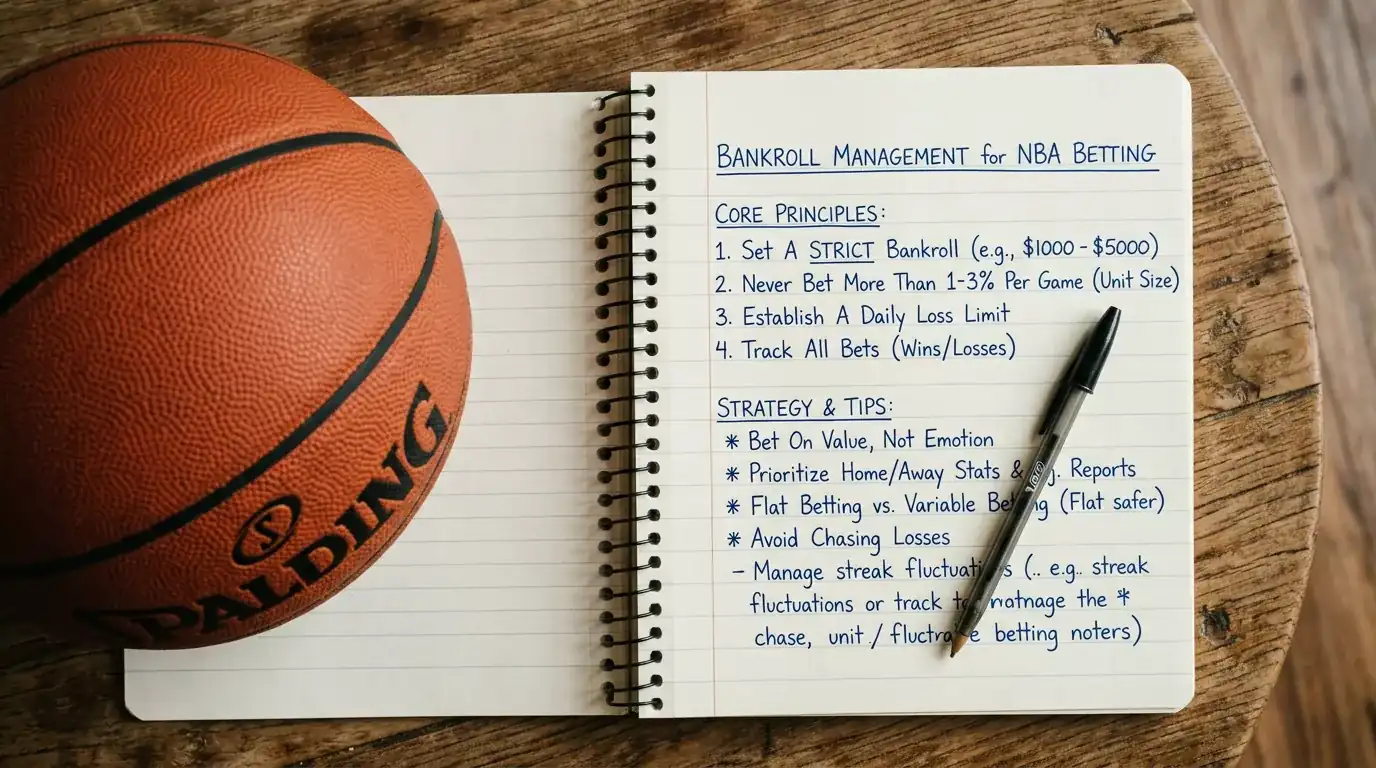
The size of your starting bankroll dictates your unit size, which dictates the range of markets available to you. On a 500-pound bankroll with 1% units (five pounds per bet), you can comfortably bet spreads and totals at most UK bookmakers. On a 200-pound bankroll with the same percentage, your two-pound stakes limit you to operators without minimum bet thresholds above that level. I recommend starting with at least 300-500 pounds as a dedicated NBA bankroll, which provides enough headroom to absorb a 15-20 bet losing streak — and those streaks happen to everyone, regardless of skill.
Unit Sizing: Flat Stakes vs Variable Staking
During the 2023-24 season, I ran a parallel experiment. I tracked my actual variable-staking results alongside a simulated flat-staking version of the same selections. After 412 bets, flat staking outperformed variable staking by 2.1 percentage points of ROI. The result did not surprise me — it confirmed what the theory predicts. Unless your confidence calibration is exceptional, flat staking is safer and often more profitable than trying to size bets according to perceived edge.
Flat staking means every bet gets the same stake — typically 1-2% of your bankroll. On a 1,000-pound bankroll at 1%, every bet is ten pounds regardless of whether you are backing a 1.40 favourite or a 3.50 underdog, regardless of whether the data screams “value” or merely whispers it. The discipline this imposes is uncomfortable but valuable: it forces your profit to come from selection quality rather than staking aggression, and it makes your results interpretable. If you win 54% of even-money bets at flat stakes, you know your edge is roughly 4%. With variable staking, the signal gets buried in noise.
Variable staking has one legitimate application: when you can genuinely quantify the probability of each bet and size accordingly. That is where the Kelly Criterion enters the conversation.
The Kelly Criterion Applied to NBA Betting
I first encountered the Kelly Criterion in a probability textbook and immediately tried to apply it to my NBA betting. The first month was a disaster — not because Kelly was wrong, but because I was feeding it garbage inputs. Kelly is only as good as your probability estimates, and most bettors overestimate their edge by a wide margin.
The Kelly formula is straightforward: stake = (bp – q) / b, where b is the decimal odds minus 1, p is your estimated probability of winning, and q is (1 – p). Suppose you estimate a bet has a 55% chance of winning at decimal odds of 1.95. Then b = 0.95, p = 0.55, q = 0.45, and the Kelly stake is (0.95 times 0.55 minus 0.45) / 0.95, which equals 7.6% of your bankroll. On a 1,000-pound bankroll, that is 76 pounds on a single bet.
That 76 pounds should make you deeply uncomfortable, because it should. Full Kelly is aggressive — designed to maximise long-term growth rate, not to minimise short-term pain. In practice, professional bettors use fractional Kelly, typically one-quarter to one-half of the full Kelly stake. At quarter-Kelly, that 76-pound bet becomes 19 pounds, which is far more survivable during a losing run. The 13.5 million active monthly online gambling accounts in the UK include plenty of bettors who blew up using full Kelly because their edge estimates were even slightly optimistic. Quarter-Kelly provides a substantial buffer against that overconfidence.
My personal approach is a hybrid. I use flat staking at 1% as my default for all bets where my quantified edge is moderate. For selections where my model projects a clear edge of 5% or more above the closing line, I move to 2% — essentially a manual half-Kelly cap. I never exceed 3% on any single NBA bet, period. That ceiling has saved me multiple times from catastrophic damage during the inevitable stretches when my model underperforms.
Surviving Losing Streaks Without Tilting
Sixteen consecutive losses. That was my longest NBA losing streak, across ten days in December 2022. Not sixteen bad bets — twelve of them lost by three points or fewer. The mathematics of a 54% bettor says a sixteen-game losing streak has roughly a 0.002% chance of occurring in any given stretch, but across thousands of bets over multiple seasons, it is not a matter of if but when.
The bankroll management framework I described above is specifically designed to make these streaks survivable. At 1% flat staking, a sixteen-bet losing streak costs you 16% of your bankroll — painful but recoverable. At 5% staking, the same streak wipes out 80% of your bankroll and effectively ends your season. At 10% staking, you are done after ten losses. The staking percentage you choose is not a measure of aggression; it is a measure of how many consecutive losses you can absorb before you are forced out of the game.
The psychological dimension matters as much as the mathematical one. After eight or nine consecutive losses, the urge to increase stakes is almost physical — your brain demands you “get it back” with a larger bet. This is tilt, and it is the single most common way competent bettors destroy their bankrolls. My defence against tilt is procedural, not motivational. My staking rules are written in a document I consult before every bet, and the document does not contain an exception clause for “I feel confident” or “I need to recover.” The rules are the rules, and the rules exist specifically for the moments when my emotional brain wants to override them.
UK gambling regulation adds a structural safeguard here. Since February 2025, operators must conduct financial vulnerability checks at a net deposit threshold of 150 pounds over 30 days. That external checkpoint, combined with the deposit limits and self-exclusion tools available at every UKGC-licensed operator, creates layers of protection that reinforce your own discipline.
When to Adjust Your Bankroll and Unit Size
Every three months during the NBA season, I recalculate my unit size based on my current bankroll. If the bankroll has grown by 25% or more, I increase my unit size proportionally. If it has shrunk by 25% or more, I decrease it. This periodic recalibration ensures my staking stays proportional to my resources without the noise of daily fluctuations.
What I do not do is recalculate after every bet. Dynamic recalculation sounds mathematically optimal — and it is, in theory — but in practice it creates two problems. First, it requires perfect discipline: you must genuinely reduce your stake after losses and increase it after wins, which conflicts with the psychological pull to chase losses. Second, it increases variance: the compounding effect works both ways, amplifying drawdowns as aggressively as it amplifies growth. Quarterly recalibration captures the compounding benefit without the daily emotional whiplash.
One final consideration: when to stop for the season. If my bankroll drops below 50% of my starting amount, I take a mandatory two-week break. Not a reduced-volume period — a complete stop. During that break, I review every bet, audit my model, and decide whether the losses reflect bad variance or a genuine deterioration in my edge. If the review shows my selections were sound but unlucky, I resume. If it shows my model has degraded, I reduce volume until I have diagnosed and fixed the problem. Bankroll management is not just about protecting money. It is about protecting the decision-making process that generates the money in the first place.
What is the ideal unit size for NBA betting?
Between 1% and 2% of your total bankroll is the range used by most disciplined bettors. At 1%, a 1,000-pound bankroll means 10-pound bets — conservative but highly resilient to losing streaks. At 2%, you accept more variance in exchange for faster growth when your selections are profitable. I default to 1% and only increase to 2% when my model identifies a clear, quantified edge of 5% or more above the market price.
How does the Kelly Criterion work for NBA bets?
The Kelly Criterion calculates optimal bet size using the formula: stake = (bp – q) / b, where b is decimal odds minus 1, p is your estimated win probability, and q is 1 minus p. Full Kelly maximises long-term growth but is extremely aggressive. Most professional bettors use quarter-Kelly or half-Kelly to reduce variance. The formula is only useful if your probability estimates are accurate — if they are even slightly optimistic, full Kelly can accelerate losses rather than gains.
Should I increase my stakes after a winning streak?
Only through scheduled bankroll reviews, never impulsively. I recalculate my unit size quarterly based on my current bankroll. If it has grown 25% or more, I increase proportionally. Increasing stakes mid-streak based on confidence rather than bankroll growth is a form of tilt that can erase gains quickly when the streak inevitably ends.
Prepared by the nba Game Betting editorial staff.